Cricket vs Baseball: The Key Differences Explained for Global Readers
Share this article
Cricket and baseball share a common ancestor — a 17th-century English children's game called "rounders," from which both descend. They are, broadly, both bat-and-ball games featuring a pitcher (or bowler) delivering a ball to a batter. From there, however, the two sports go in radically different directions: different fields, different scoring, different equipment, different match formats, and different cultural homes.
This guide is for the curious global reader who knows one of the two sports and wants to understand the other. We'll cover the rules, the scoring, the equipment, the format differences, and where the two games quietly converge.
The core difference in one sentence
In baseball, you score runs by hitting the ball and running around four bases (a diamond) to home plate. In cricket, you score runs by hitting the ball and running between two stumps (a single straight line). One uses a diamond. The other uses a line.
That single structural difference cascades through every other rule.
The field
| Feature | Cricket | Baseball |
|---|---|---|
| Shape | Oval | Diamond + outfield |
| Size | ~150m × 130m | ~110m × 120m |
| Pitch | 22 yards / 20.12 m | 60.5 feet / 18.4 m (mound to plate) |
| Surface | Mostly grass; pitch is bare | Mostly grass; mound is dirt |
| Boundary | Marked rope/line | Outfield wall |
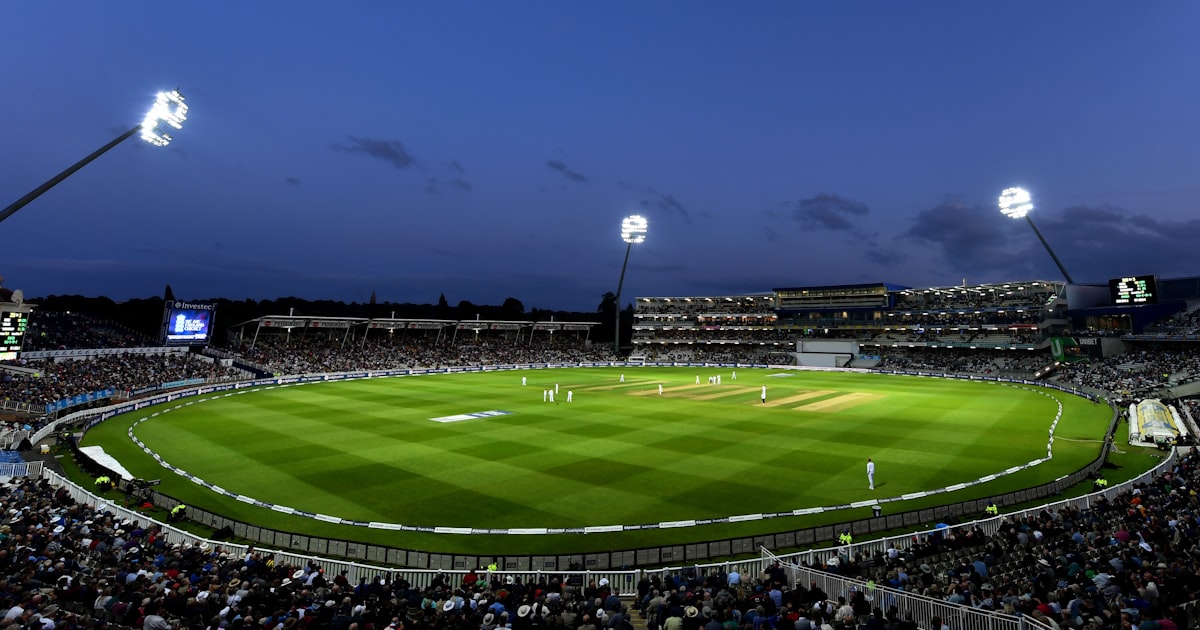
A cricket field is a rough oval, with a 22-yard rectangle in the middle (the "pitch" or "wicket") where the actual bowling and batting take place. Everything else is the outfield.
A baseball field is a diamond — four bases at right angles to each other, with a "pitcher's mound" in the middle. The outfield is roughly fan-shaped beyond the diamond.
For a deep dive on fielding positions, see our cricket fielding positions guide.
The bat and ball
| Feature | Cricket | Baseball |
|---|---|---|
| Bat shape | Flat, paddle-shaped, wood (willow) | Round, tapering, wood or aluminium |
| Bat length | ~96 cm | ~106 cm |
| Bat weight | ~1.2 kg | ~0.9 kg |
| Ball | Hard leather; cork core | Hard leather; cork/rubber core |
| Ball weight | 156 grams (5.5 oz) | 142-149 grams (5-5.25 oz) |
| Ball seam | Prominent stitched seam | Raised stitched seam |
Both games use a hard leather ball, but the bats are very different. A cricket bat has a flat front face, designed for striking the ball forward (towards the bowler) along the ground. A baseball bat is round, designed for striking the ball in any direction.
The cricket ball has a more pronounced seam, which is critical to swing and seam bowling. The baseball ball has a smoother seam designed for the pitcher's grip.
How runs are scored
Cricket
A run is scored when the two batsmen, having struck the ball, run between the two sets of stumps. They can run multiple times for a single hit:
- One run — running from one end to the other once
- Two runs — running and back, twice
- Three runs — three times (rare)
- Four runs (boundary) — the ball is hit out of the marked playing area on the bounce
- Six runs (six) — the ball is hit out of the marked playing area on the full
The two batsmen always run together — they cross paths. There is no "base running."
Baseball
A run is scored when a runner reaches home plate after touching first, second, and third base in order. Each at-bat results in:
- A hit — reaching first base on a contact
- A double — reaching second base
- A triple — reaching third base (rare)
- A home run — hitting the ball over the outfield wall on the full
A runner can only score by completing the full base path back to home plate. Multiple runners can be on base at once.
The structural difference: cricket runs are scored on every successful run between stumps; baseball runs require completing the base loop.
The bowler vs the pitcher
| Feature | Cricket bowler | Baseball pitcher |
|---|---|---|
| Action | Run-up + arm-swing delivery | Stationary windup |
| Ball pace | 130-160 km/h fast; 80-110 km/h spin | 130-160 km/h fast |
| Pitch length | 22 yards (20.12 m) | 60.5 feet (18.4 m) |
| Variations | Pace, swing, seam, cutters, spin | Fastball, curveball, slider, change-up |
| Delivery limit | 6 balls per over (by rotation) | No specific limit per inning |
Cricket bowlers have a 22-yard run-up and deliver the ball with a near-straight arm. Baseball pitchers stand on a mound, generate power from a windup, and deliver from a 60.5-foot distance.
Both rely on velocity, deception, and movement. The technique is different but the goal is the same: get the batter out.
For a guide to specific spin styles, see our left-arm orthodox spin history.
How a batter is dismissed
Cricket
Eleven main ways. The most common:
- Bowled — the ball hits the stumps
- Caught — the ball is caught in the air after striking the bat (or glove)
- LBW (Leg Before Wicket) — the ball would have hit the stumps if not for the batter's leg
- Run out — a run is attempted but the batter is short of the crease when the wicket is broken
- Stumped — the wicketkeeper breaks the stumps when the batter is out of the crease
Baseball
Three main ways:
- Strikeout — three strikes (failed swings or pitches in the strike zone) without a hit
- Caught fly — the ball is caught in the air without bouncing
- Tag/force out — the runner is tagged or beaten to a base by a fielder
Cricket has more granular dismissal types because the playing surface is more contested (the pitch and stumps).
The format
| Feature | Cricket Test | Cricket ODI | Cricket T20 | MLB game |
|---|---|---|---|---|
| Innings per side | 2 | 1 | 1 | 9 (alternating) |
| Length | Up to 5 days | ~7-8 hours | ~3 hours | ~3 hours |
| Players per side | 11 | 11 | 11 | 9 |
| Substitutions | Limited | Limited | Limited | Mostly free |
Test cricket lasts up to 5 days. The other format closer to baseball in feel is T20 cricket — a single innings per side, ~3 hours, fast-paced.
Baseball is essentially a 9-inning game where each team alternates batting and pitching. Cricket has separate batting and bowling innings.
Number of players
- Cricket: 11 players per side
- Baseball: 9 players per side
Both sports field a team in defence, with each player having specialised positions. In cricket, all 11 fielders are on the field at once. In baseball, 9 players are on the field per inning, and there are typically additional bench players.
For cricket positions, see our fielding positions guide. For baseball, the equivalent positions are pitcher, catcher, infield (1B/2B/3B/SS), and outfield (LF/CF/RF).
Time of play
- Test cricket: Days 1-5, with three sessions per day (~6 hours of play). Drinks breaks. Lunch. Tea.
- ODI cricket: ~7-8 hours, often a day-night match.
- T20 cricket: ~3-3.5 hours.
- MLB game: ~3 hours, with seventh-inning stretch and other interruptions.
The pace of cricket is more deliberate; the pace of baseball more rapid in micro-decisions but slower overall in plays per minute.
Cultural homes
| Country | Major sport |
|---|---|
| India, Pakistan, Bangladesh, Sri Lanka | Cricket |
| Australia, England, South Africa, NZ, WI | Cricket |
| US, Canada (in part), Cuba, Dominican Republic, Japan, South Korea | Baseball |
| Caribbean (Dominican, Cuba, Puerto Rico) | Baseball |
Cricket is the global second-most-watched sport (after football). Baseball is dominant in North America, the Caribbean, and East Asia.
The two sports are converging slightly: Major League Cricket (MLC) launched in the US in 2023, and the IPL has a small but growing US viewership. Both leagues are creating cross-pollination.
Where the two games converge
Despite the differences, three things are similar:
- Both are bat-and-ball games with deep statistical traditions.
- Both have multiple formats within their sport (Test/ODI/T20 in cricket; MLB regular/post-season in baseball).
- Both have player roles — the pitcher/bowler, the batter, the catcher/wicketkeeper — that are highly specialised.
The deep emotional shape of both sports is also similar: both are slow games punctuated by moments of high drama, both reward technique over raw athleticism, and both have huge statistical fan bases.
A short note on cricket-baseball crossovers
A few players have moved between the two:
- Ed Cowan (Australian Test batter) played semi-professional baseball as a young man.
- The Wright brothers (American cricket pioneers) helped formalise both sports' rules in the 19th century.
- Adam Gilchrist (Australian wicketkeeper-batsman) trained with the Boston Red Sox briefly during a US tour.
The crossovers are rare but real. The two games share enough fundamentals that elite athletes can play both at amateur level.
For more on the historical context of cricket, see our Bodyline series guide and the most runs in Test cricket all-time.
Which is better for beginners?
The honest answer: cricket has more rules to learn, but baseball has more situations to memorise.
A new viewer of cricket has to learn 11 dismissal types, the differences between formats, fielding positions, and the basic geometry of the pitch. After that, the game is fairly simple.
A new viewer of baseball has to learn 4 base paths, double plays, force-outs, and the strike zone. After that, the game is fairly simple.
Both reward time and patience. Both have communities online who will explain things kindly.
Frequently Asked Questions
Are cricket and baseball related? Yes. Both descend from a 17th-century English game called rounders. The two sports developed independently from rounders into different forms — cricket in 18th-century England, baseball in 19th-century America.
Is cricket harder than baseball? Different skill sets. Cricket has more dismissal types and more diverse bowling styles. Baseball has more position specialisation and faster pitching velocities.
Does the cricket bat hit harder than the baseball bat? Cricket bats are heavier (~1.2 kg vs ~0.9 kg) but baseball balls are lighter (~145g vs 156g). Both produce similar maximum exit velocities (around 110-120 mph), with baseball typically producing higher contact-angle hits.
How long is a cricket match vs a baseball game? A Test match is up to 5 days. A T20 match is ~3 hours. A baseball MLB game is ~3 hours. The closest cricket format to baseball, in pace, is T20.
Why do cricket players wear more padding than baseball players? Cricket batters face deliveries at body height with no shielding except the bat. Baseball batters face pitches at face height but wear minimal protection beyond a helmet. Cricket's pad system protects against bone-fractures from short balls.
The two sports are cousins separated by an ocean and three centuries. Each is the dominant bat-and-ball game in its hemisphere. Each is, in its own way, a complete tactical universe. If you know one, you can learn the other in an afternoon. If you love one, the chances are reasonable you'll find something to love in the other.
Share this article
Rahul Sharma
Expert in: How To GuidesRahul Sharma has played district-level cricket in Mumbai for 8 years and has personally tested more than 50 bats, pads, gloves, and helmets across different price ranges. He joined CricJosh to help Indian club cricketers make smarter equipment choices without overpaying. His reviews are based on real match and net session use, not sponsored samples.
Why trust this review: Rahul has used every product in this review across multiple match and net sessions before writing a word. He buys equipment at retail price and accepts no free samples.
Related Articles
11 min read · 2 May 2026
11 min read · 2 May 2026